
Winter is Here! Retractable Awning Preventive Maintenance Tips
Now that cold weather and wintertime has arrived with even more rain and snow in the forecast, it is important to remember that severe weather conditions can compromise the safety and proper operation of your retractable awning. We will consider some pointers to protect your product investment.
Awning location:
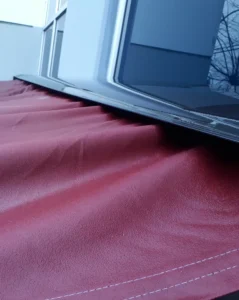
If your awning is installed on a flat wall, make sure to check that the mounting brackets are firmly fastened tight against the wall, especially if mounted on top of a weaker material such as vinyl siding or stucco. On such installations, we recommended that you add a 2” x 12” ledger board (good quality lumber) be firmly bolted to your wall, to which the retractable awning brackets will then be lag bolted to the ledger board for optimal strength.
Check all mounted lag bolts and brackets once a year to make sure vibration and torque have not loosened the fasteners. If you find any that are loose, tighten them with a hex or socket wrench. This will prevent any excessive movement or flex of the awning upon its projection and retraction during the season. Once winter comes your awning will be in top condition to handle any surprise weather pattern.
Check soffit brackets and ensure there be no spaces between soffit surface and bracket tops.
As for roof mount awning brackets, check that the roof area under the brackets is firm and solid with no cracked caulking or visible signs of rotten lumber or soft spots.
When it rains:

In rainy weather, be sure to keep the awning completely rolled up at all times (retracted) to keep the fabric from being exposed to the extra weight of water on the fabric. Onceawning fabric gets wet, the extra weight increases the chances of damage. An unexpected wind can cause excessive force so strong that it can actually cause a component of the awning to break. The additional weight can cause undue stress and torque on the vital parts of the awning structure so as to compromise the structural integrity of joints and brackets. If the awning has no hard top cover, it is recommended to at least cover the awning with custom made winter fabric covers (available from some manufacturers), or install an after-market aluminum awning cover to keep it safe from moisture, falling tree limbs, ice and snow loads.
When it snows:
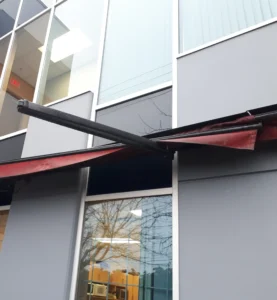
Most modern high quality awnings now come with protective hoods as part of the awning system to prevent damage to the fabric and tubular motor. These types of awnings are called semi-cassette or full cassette (box) awnings. Even though they have a protective hood on the top of the roller tube and fabric, it is imperative that you keep the awning completely rolled up and retracted when not in use, and make sutre you do so only in dry weather and above-freezing temperature. This will ensure that no ice buildup gets hidden in the fabric roll (which could cause major damage when the awning is extended or retracted). Ice shards can be hard and sharp enough to puncture through awning fabric, whereas ice accumulation (and extra weight) could cause permanent warping or stretching of the fabric – which affects the latter’s appearance and performance.
When it freezes (less than 0°C or 32°F):
As another rule of thumb, you hould never be leave your retractable awning open when it is snowing, even if you just want to keep your patio free of snow. It just is not worth the risk!
When the outside temperature is below freezing 0°C or 32°F, avoid opening or closing the awning manually or remotely, as accumulated ice could cause damage to the fabric when it is projected out or retracted in. Do so with extreme care only in an emergency – preferably with a hand crank taking care not to force any parts and this only to be retracted inwards, never to project it out.
Retractable awning frames can snap unexpectedly under the weight of a snow load without warning by either one or both arms breaking or from forcing the lag bolts out from the wall due to the heavy torque caused by the extra weight.
Extreme weather:
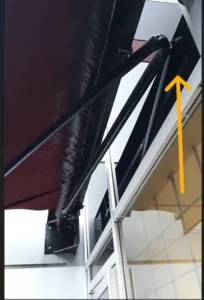
When you receive word of a severe wind, rain, ice or snow storm forecast take a minute to check and make sure that all awning brackets – including wall brackets, soffit mount brackets, and roof mount brackets – are securely tightened with zero movement tolerance. A properly fastened retractable awning with the adequate size and number of fasteners (proportional to the size of the awning) greatly increases the safety of household members, plus ensures the safety and integrity of the awning investment itself.
The result? A well-secured awning (completely retracted) with an appropriate protective cover will remain perfectly in place through most major storms for the life of the awning.
Note – Never leave your awning extended while absent from your home as sudden gusts of wind can damage an awning in a matter of seconds. Wind sensors are available for quality motorized awnings to prevent this from happening. If you already have a wind sensor installed, check or replace wind sensor batteries once a year.
Retractable awnings, accessories, brackets and replacement parts are available at www.lumasso.com
Need help? Email us at info@lumasso.com